
Nov 01, 2026
Heavy Duty Gun Safe: What to Check Before You Buy
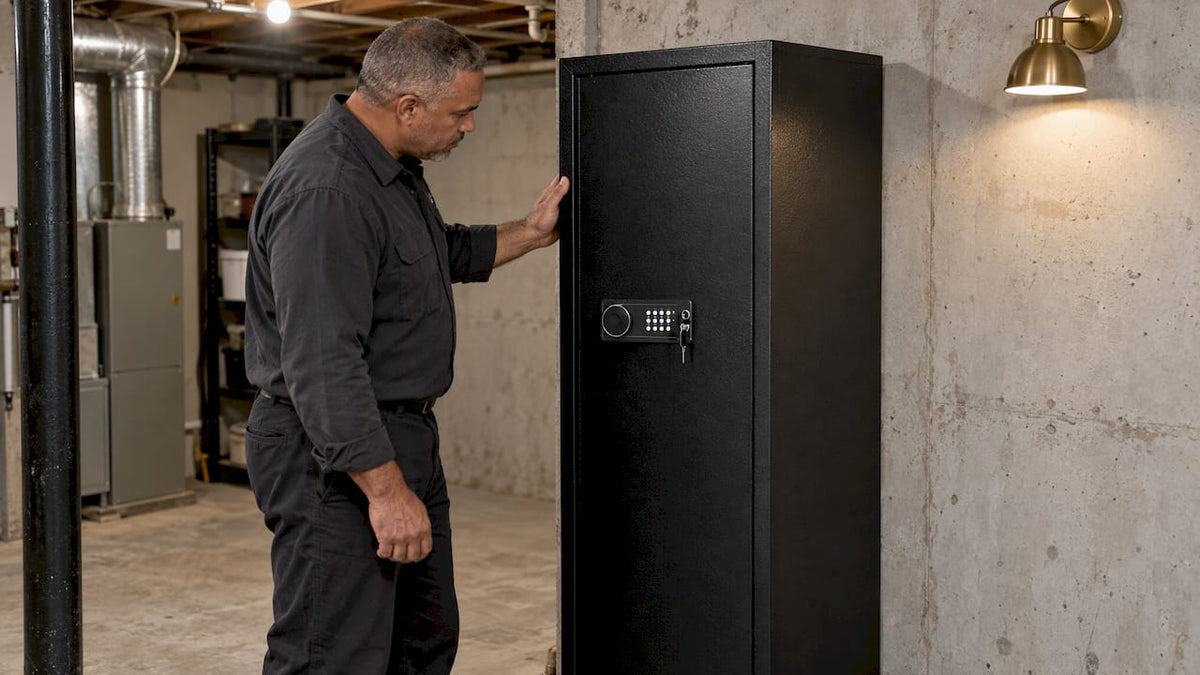
A heavy duty gun safe is one where the steel body, the door, the lock and the bolts are built to work as one system against pry, drill and cut attacks, and where the safe is anchored to the structure it sits in. Thick steel alone does not make it heavy duty. This guide shows which specs to compare, which claims to verify, and how to match the safe to your firearms and your home.
TL;DR
- Judge the whole safe: body steel, door construction, lock protection and bolt engagement all count, and the weakest one sets the real limit.
- Steel thickness is a starting point. Gauge numbers are lower for thicker steel, and 10-gauge is commonly cited as a practical minimum for serious security.
- Look for a UL 1037 residential security container rating if you want a tested security level rather than a marketing line.
- Fire ratings often come from manufacturer tests, so compare the test method, not the headline number.
- Buy more capacity than you need today, and bolt the safe down. An unanchored safe can be carried off.
Table of Contents
- What actually makes a gun safe heavy duty
- Steel gauge: the number people compare first
- Locks and boltwork: where speed meets security
- UL 1037: the tested security levels
- Fire ratings: compare the test, not the number
- Size: buy for the collection you will have
- Installation and anchoring
- Budget: what the money buys
- Perspective: why we sort safes by job
- Safe storage habits that go with any safe
- Where our products fit
- A buying checklist you can take with you
- FAQ
- Sources
What actually makes a gun safe heavy duty
The phrase has no legal definition, so it helps to break it into parts. A heavy duty safe has reinforced steel construction, a door designed with minimal gaps, a protected locking system with hard plates and relockers, and proper anchoring to a permanent structure, according to one buying guide on steel construction. The same guide makes the point that matters most: a safe is only as strong as its easiest point of failure.
That is why a thick body with a thin door, or a thick door with an unprotected lock, is not heavy duty in practice. Someone attacking a safe goes for the weakest spot, so you should check the weakest spot first.
Here is a quick way to think about it:
| Part | What heavy duty looks like | What to ask |
|---|---|---|
| Body steel | Thick, continuously welded walls | What gauge, and is the number for the body or just the door? |
| Door | Plate or reinforced composite, tight fit, reinforced frame | How much gap is there around the door edge? |
| Lock | Quality electronic, mechanical dial or keypad with hard plate protection | Is the lock UL-listed and shielded? |
| Bolts | Bolts that engage the frame in useful places | Where do they sit, and how deep do they go? |
| Anchoring | Pre-drilled holes and hardware for floor mounting | Can it be bolted to slab or framing? |
Steel gauge: the number people compare first
Gauge is counted backward: a lower number means thicker steel. The same steel-construction guide calls 10-gauge a practical minimum for serious security, and says 7-gauge or thicker is a more meaningful barrier against pry bars and basic cutting tools. Treat those as rules of thumb from a buying guide, not a certification.
Two habits make gauge numbers more useful:
- Check body and door separately. Brands often quote the best figure in the spec. Ask which part it describes.
- Look at construction, not only thickness. Continuous welds, a reinforced door frame and a solid plate or composite door matter as much as a single thickness figure.
If a product page lists no gauge at all, read the full specification and description before you decide, and compare it only with safes that tell you the same things.
Locks and boltwork: where speed meets security
A safe you can’t open quickly in the dark is a safe you may stop using. A safe that opens too easily for the wrong person defeats its purpose. The lock sits right at that trade-off.
An NRA-affiliated shopping guide lays out the basic options: combination locks need no batteries but are slower, electronic locks are easy to use but need battery changes, and biometrics are fast but can fail with a dirty finger and cost more. Another guide adds that dependable keypads or mechanical dials are usually better primary options than low-cost biometrics, which can disappoint in dusty garages or humid basements.
What that means in practice:
- Home defense at the bedside: you want speed. Multi-method access (fingerprint, code and key) gives you a backup when one method fails. Keep the backup key or code somewhere that only you can reach.
- Garage, basement or workshop: dust, damp and temperature swings are tougher on sensors. Favor a keypad or mechanical option as your main method.
- Long-term storage: a battery-powered lock needs a calendar reminder for battery changes.
On bolts, the guidance is to assess placement and engagement, not just count. Ten bolts that barely reach the frame are less useful than fewer bolts that seat well. Ask for a diagram or a clear spec if the listing only says “multi-bolt.”
UL 1037: the tested security levels
If you want an independent yardstick, look for a Residential Security Container listing. Gun safes of this kind are covered by UL 1037. UL revised the standard in 2016 from a single five-minute hand-tool attack test to a three-tier system, with attack levels that add ten-minute tests and more aggressive tools. The point of the tiers is that you can choose the security level that suits what you are protecting.
The same page notes that a drop test applies to containers weighing 750 pounds or less, unless they can be reliably and safely mounted and the manufacturer provides installation provisions and instructions. For lighter safes, that is one more reason to bolt them down properly.
When you compare safes, a listed attack level tells you more than the word “heavy duty” in a product title. If a safe is not listed, you can still evaluate it, but by the physical checks in this guide.

Fire ratings: compare the test, not the number
A fire rating normally states how long the interior stays below a certain temperature, such as 350°F, while the outside is exposed to heat. The catch is that gun safe fire ratings lack a standard metric: manufacturers may use their own tests, and few test at third-party laboratories.
So when two safes both say “60 minutes,” ask:
- Who ran the test, and is the data available?
- What interior temperature was the target?
- Does the rating cover the door seal and the body, or just the walls?
If you store paper documents, remember that paper and electronics have different tolerances than firearms. Pick your rating with your contents in mind.
Size: buy for the collection you will have
Most owners outgrow their first safe. The shopping guide advises allowing more space than you think you need, both for collection growth and for items such as documents, and suggests considering drawers, door pouches and filing space.
A practical sizing method:
- List every firearm you own, plus any you expect to add in the next few years.
- Note the longest (rifle with optic) and the widest (scoped or tactical stocks).
- Add room for magazines, cleaning kit, ear protection and papers.
- Add roughly a third more. Packed safes slow down access and scratch finishes.
For rifles and shotguns, a dedicated long gun cabinet works well. For handguns, a compact quick-access box or drawer safe keeps one pistol ready without opening a full-size vault.
Installation and anchoring
An unanchored safe, however thick, can be tipped onto a hand truck. The guide recommends bolting the safe to the floor, planning for professional installation, and assessing floor strength unless the safe sits on a concrete slab. It also advises that you prioritize box structure and insulation before bolts, hinges and locks.
Checklist before delivery day:
- Measure the path: doorways, stairs, corners and hallway turns.
- Decide where it will sit. A corner against two walls limits pry angles and hides the sides.
- Confirm the floor: concrete slab is the easiest case; a wood floor may need reinforcement and the right hardware.
- Hold the anchor bolts and fasteners that suit your floor type before you start.
If you rent, there are options that don’t involve drilling through the slab. Our guide to an apartment gun safe for renters covers how to choose and secure one when you can’t make major changes.
Budget: what the money buys
The same guide puts the minimum price for actual security at about $1,200 to $1,500, and notes a safe may qualify as a tax write-off, so ask a tax preparer. Price is not everything, but very low prices in the big-safe category usually mean thin steel or a minimal door. Smaller cabinets and quick-access boxes sit in a different role: they keep firearms locked and out of reach of children and visitors, and they cost less because they do less. Be honest about which job you need done.
Perspective: why we sort safes by job
We build our catalog around one idea: a firearm should be locked away from anyone who shouldn’t have it, and quick to reach for the person who should. Those two goals pull against each other, so we don’t think one safe fits every owner.
That is why we separate storage into roles. A long gun cabinet with fingerprint and keypad access is for rifles and shotguns that need organized, secure storage. A quick-access biometric box is for the handgun at the nightstand. Each is designed to give you precise engineering and modern security technology where you actually use it, without making you choose between safety and convenience.
Our advice is to match the lock to the room, match the capacity to the collection you’re building, and anchor everything. Our customers’ reviews point to craftsmanship and function, and that is the standard we hold every product to.
the author
Safe storage habits that go with any safe
The safe is one piece. Colorado’s health department says secure storage means locking firearms in a safe or lock box, or using a device such as a cable or trigger lock, and that hidden firearms are not securely stored. The same page recommends storing firearms locked and unloaded, with ammunition stored separately, and reviewing your storage practices regularly to prevent unauthorized access by children or others.
The NSSF also advises unloading sporting firearms before bringing them into the home, storing firearms locked and ammunition separately, and checking that firearms remain unloaded after storage.
If a home-defense handgun needs to stay ready, a quick-access safe with a reliable lock is the way to keep it secure and still reachable. Decide who in the household knows the code or has fingerprints enrolled, and review that list when circumstances change. Your state may have its own storage laws, so check your state’s rules or ask a local firearms attorney.

Where our products fit
We sell secure storage in the roles described above. For rifles and shotguns, the metal gun security cabinet with fingerprint and keypad access and the 6-8 rifle safe with a digital keypad give you organized long gun storage with lock-based access. Check each product page for the specifications and dimensions before you order, and compare them against the checklist above.

For the handgun you want within reach, the gun safe with screen and fingerprint, password or key access offers three ways in, so a failed fingerprint read doesn’t leave you locked out. You can browse the full range of safes, racks, carry bags and cases at USA.armed.
A buying checklist you can take with you
- Define the job: long gun vault, bedside quick access, or both.
- Read the steel spec: body and door gauge, welds, frame.
- Check the lock: primary method suited to the room, plus a backup.
- Look for a UL 1037 listing if you want a tested attack level.
- Ask about fire testing: who tested, to what temperature, for how long.
- Size up: more room than the collection needs today.
- Plan the anchor: floor type, hardware, delivery path.
- Set household rules: who has access, where ammo goes, when you review.
FAQ
What gauge steel should a heavy duty gun safe have?
A buying guide on steel construction calls 10-gauge a practical minimum for serious security and 7-gauge or thicker a stronger barrier against pry bars and basic cutting tools. Lower gauge numbers mean thicker steel. Ask whether the figure applies to the body, the door or both.
Is a fireproof rating the same as being heavy duty?
No. Fire resistance and attack resistance are separate qualities. UL describes residential security containers as designed for security, unlike fire-resistant containers. Fire ratings also often come from manufacturer tests, so look for the test method behind the number.
Do I need to bolt my gun safe down?
Yes, bolting to the floor is the standard advice, because it prevents the safe being removed by hand truck. Check your floor type first: concrete slab is simplest, while other floors may need strengthening. Professional installation is recommended.
Is a biometric lock good enough for a heavy duty safe?
Biometrics are fast, which suits a bedside safe, but they can fail with a dirty finger and can struggle in dusty or humid spaces. Choose a model that also offers a keypad or key backup, and use a keypad or mechanical dial as the main method in garages and basements.
Sources
- Residential Security Container Standard Revised, UL Solutions
- Safe Shopping: Finding the Right Firearms Vault, Shooting Sports USA
- Gun Safe Steel Construction: What to Check Before Buying
- Secure firearm storage, Colorado Department of Public Health and Environment
- Securely Storing Firearms in the Home, NSSF