
Oct 31, 2026
Gun Rack in a Closet: How to Set One Up Safely
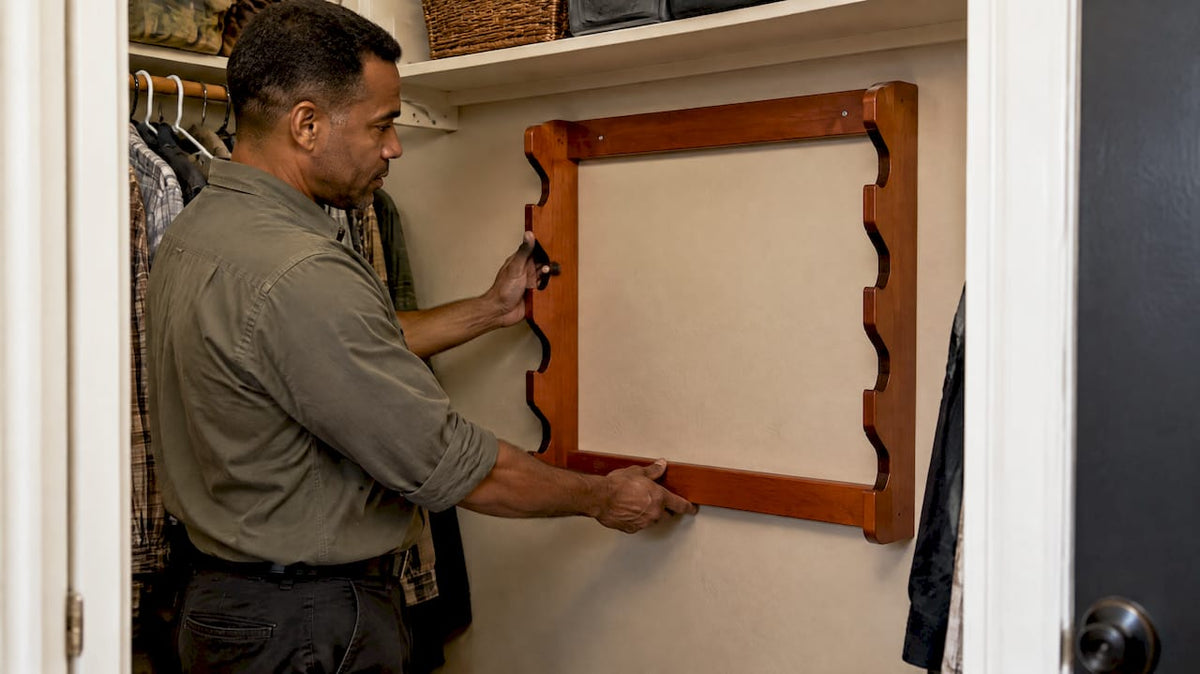
A closet is a good place for long-gun storage: it is out of sight, close to where you live, and it uses space you already have. A rack can organize rifles and shotguns there neatly. But a rack holds guns in place and does not lock them away. In a closet, the safe setup is a rack inside a locked space, or a locking safe or cabinet sized to the closet. This guide covers how to choose, measure and install, and how to keep access quick for you and impossible for anyone else.
TL;DR
- A rack organizes long guns. It does not secure them. The U.S. Department of Justice says gun safes provide the most secure storage, so pair any rack with a lock you control.
- Hiding a gun in a closet is not safe storage. Children are curious and may find it.
- Measure the closet width, depth, height, door swing and floor before you buy anything.
- Store firearms unloaded and locked, with ammunition locked in a separate place.
- Check your state and city rules for secure-storage requirements before you set up.
Table of Contents
- Why a rack alone is not enough in a closet
- Rack, cabinet or safe: how they compare in a closet
- Choosing a closet rifle rack
- How to plan and set up the closet
- Balancing quick access with keeping guns away from kids
- Ammunition and the rules where you live
- What first-time buyers should check
- Our perspective
- Get the closet set up
- FAQ
- Sources
Why a rack alone is not enough in a closet
A wall rack is built for display and tidy access. Barrels sit in cradles and stocks rest on padding, so every gun is visible and reachable. That is the appeal, and it is also the limit: anyone who opens the closet door can reach them.
The Department of Justice is direct on this point. Its guidance says hiding a firearm in a closet, drawer or similar spot is not safe storage, because children are curious and might find it. It also notes that cable locks can be defeated by a determined person with tools. So the question is not “rack or no rack.” It is “what keeps the rack from being open to everyone?”
There are three common answers:
- A rack inside a locking cabinet or safe. The rack gives you organization and the enclosure gives you security.
- A rack in a closet that locks. A solid door with a deadbolt-style lock you control can work as the secured space. Only adults should have the key or code.
- A rack plus a lock on each gun. Trigger or cable locks add a layer. Project ChildSafe says a gun lock is an extra precaution and not a substitute for secure storage.
Rack, cabinet or safe: how they compare in a closet
| Option | Best for | Access speed | Security level | Closet fit |
|---|---|---|---|---|
| Open wall rack | Display and organizing inside an already-locked space | Fastest | Lowest alone | Slim, wall-mounted, uses vertical space |
| Locking long-gun cabinet | Several rifles or shotguns in one place | Fast with keypad or fingerprint | High | Needs floor space and a clear door swing |
| Rifle safe with digital keypad | Larger collections and long-term storage | Fast with keypad, slower than a rack | High | Needs measuring for width, depth and door opening |
| Small quick-access pistol safe on a shelf | Handguns near where you need them | Very fast | Moderate to high | Shelf or floor, small footprint |
The NRA’s safe-storage guidance describes the trade-off plainly: long-term safe storage gives more protection but slows access, while quick-access methods are easier to reach with less protection. A biometric or keypad lock sits in the middle, which is why those mechanisms are popular for home defense.
The VA’s “Minutes Matter” guide makes a related point: a gun safe takes more time to open than a nightstand. Practice is the answer. Open your safe in the dark a few times until it is routine.
Choosing a closet rifle rack
For a closet, a few details matter more than they would in a gun room.
Wall-mounted or freestanding
A wall-mounted rack keeps the floor clear and suits narrow closets. Freestanding racks are easy to move, but they can tip and they take floor space you may need for the door swing. In most closets, a wall mount is the better fit, as long as the wall behind it can carry the load.

Capacity and weight rating
Count your long guns and add one slot for growth. Then check the rack’s rated load. For example, our wood wall-mount rack is listed for five rifles or shotguns and a 132 lb load. Our six-slot metal rack is listed for six guns and 180 lb. A closet wall is often narrower than a living-room wall, so match the rack width to what you actually have.
Padding and contact
Soft padding in the cradles protects finishes and optics from scratches. Leave space between guns so stocks and scopes do not knock together. Always seat the gun fully before you close the closet.
Material and look
Wood suits a den or office closet that doubles as a display. Metal is slimmer and reads as more utilitarian. Choose the one that matches the room and the weight you plan to hang.
Sporting-style racks
If you keep hunting or sporting guns, a compact sporting gun rack can be a practical fit for a shorter wall section.
How to plan and set up the closet
Good storage starts with a tape measure, not a shopping cart.
- Empty the closet. You need to see the real walls, floor and ceiling.
- Measure everything. Record width, depth and height. Note the door opening, the swing direction, baseboards, shelves and the path from the room to the closet. A safe or cabinet must pass through the doorway and its own door must open fully once it is inside.
- Check the floor. A loaded long-gun safe is heavy. Look for a firm, level floor. If you are on an upper level or an older house, ask a contractor whether the floor is suitable.
- Find the studs. Wall racks should be fastened into studs or solid backing, not drywall alone. Use the hardware and instructions that come with the rack.
- Anchor as the maker instructs. Safes and cabinets usually come with anchoring guidance. Follow it, and check with your landlord first if you rent. Our guide to an apartment gun safe for renters covers options that work without drilling into a lease.
- Plan the layout. Put long guns on the rack or in the cabinet. Put the small items on a shelf in a locked compartment. Keep ammunition elsewhere (more on that below).
- Add a light and a hygrometer if the closet is damp. Moisture damages guns. A closet on an exterior wall or near a bathroom can be a problem.
Closet gun safe ideas that save space
- Slim long-gun cabinets. A narrow cabinet with a fingerprint or keypad lock turns a single closet bay into locked storage. Our fingerprint and keypad long-gun cabinet is built for that kind of use.
- A rifle safe with a digital keypad. The 6-8 rifle safe suits a deeper closet where you want a full enclosure.
- Shelf-mounted safes. The Patriot gun safe shelf turns shelf space into a locked compartment, so the closet does not have to be reorganized from scratch.
- Small safes for handguns. A compact biometric pistol safe holds two pistols and opens quickly with a fingerprint.
- Use vertical space. Ammo goes in a separate locked container, ideally outside the closet or in a different locked compartment. Items you use less often go up high.
Balancing quick access with keeping guns away from kids
Most owners want two things at once: fast access for themselves and zero access for everyone else. The two are compatible if you layer your storage.
The Department of Justice’s guidance recommends storing firearms unloaded and locked, with ammunition in a separate locked place, and keeping keys and codes away from anyone but authorized adults. Treat every firearm as if a child could find it.
Here is how that looks in a closet:
- Biometric or keypad locks give fast, key-free access. Pick a keypad code that is not a birthday or an address.
- Redundant devices such as a cable or trigger lock add a second barrier inside the enclosure.
- Keys and codes stay with the adults who need them. Do not tape a key above the door frame.
- Talk with household members. Children who know the rules and the reasons are safer than children who just find a locked door.
The Johns Hopkins Center for Gun Violence Solutions describes storage as a spectrum. Any step toward securing a gun is an improvement, and the best practice is an unloaded firearm in a locked container with ammunition locked separately. The NSSF also notes that secure storage gives time and space in a moment of crisis, which matters for everyone in the home, not only for children.
If you or someone in your household is going through a hard time, the VA’s Minutes Matter plan helps you pick storage options and extra steps. Those can include removing a firing pin. Speak with a mental-health professional or call or text 988 in the U.S. if you are worried about someone’s safety.
Ammunition and the rules where you live
Keep ammunition in its own locked container, apart from the guns. Project ChildSafe’s guidance is to keep firearms unloaded and locked in a cabinet, safe, vault or case, with ammunition locked separately. A closet shelf with a lock box meets that standard. A cardboard box on the floor does not.
On the legal side, federal law generally bars transferring a handgun or handgun-only ammunition to anyone under 18, with narrow exceptions such as supervised target practice or hunting. That is a floor, not a full picture. Many states and some cities have their own secure-storage or child-access-prevention rules, and they differ in what they require and how they define a locked container. Check your state attorney general’s site or your local police department before you finalize the setup, and recheck if you move.
What first-time buyers should check
The NSSF says to choose the storage mechanism that fits your lifestyle, priorities and environment. In practice, that means asking six questions:
- What am I storing? Rifles and shotguns need a long-gun solution. Pistols can live in a small safe on a shelf.
- Who lives here? Children, roommates and frequent guests raise the security level you need.
- How fast must I get in? Home defense points to a quick-access lock. Long-term storage can use a slower, more secure mechanism.
- What access methods do I want? Biometric, keypad and key each have trade-offs. A multi-method lock gives you a backup if the battery or sensor fails.
- Does it fit? Use your closet measurements. Check the door opening and the swing.
- Does it have room to grow? Buy one slot more than you need.
Our perspective
We build our selection around one idea: security should not cost you speed, and speed should not cost you security. A closet is a smart place for firearms because it is close and private, but a closet is not a lock. That is why we favor a rack or shelf inside a locked enclosure, or a locking cabinet or safe sized to the space.
In our experience as a curated storage store, the setups that work best are the simple ones. A keypad or fingerprint cabinet for long guns, a small quick-access safe for a handgun, and a separate locked place for ammunition. Each piece does one job. Our products are designed to give you tailored locking and quick access without a complicated routine, and many customers tell us in their reviews that the build and function are what they notice first.
If you are starting from scratch, measure first, decide how fast you need access, and choose the lock that you will actually use every day. A lock you skip is no lock at all.
the author
Get the closet set up
If your closet already has the space, start with the piece that matches your guns. For a wall rack, our wood wall rack and metal six-slot rack both come with soft padding. For a locked option, see our rifle safe with a digital keypad, or browse every safe, rack, carry bag and case in the USA Armed store.

FAQ
Is a gun rack in a closet safe?
Only if the closet or the rack is locked. The Department of Justice says hiding a gun in a closet is not safe storage because children may find it. Put the rack inside a locking cabinet, or make the closet itself lockable, and keep ammunition separately locked.
Can I put a gun safe in a closet?
Yes, if it fits. Measure the closet, the doorway and the door swing, and make sure the safe door can open fully once it is in place. Check that the floor can take the weight, and anchor the safe following the maker’s instructions.
What is the best gun safe for a closet?
It depends on what you store. Long guns call for a slim cabinet or rifle safe with a keypad or fingerprint lock. Handguns fit in a small quick-access safe on a shelf. Choose by your guns, your measurements and how fast you need access.
Should ammunition be stored in the same closet?
It can be in the same closet, but not in the same container. Keep ammunition in a separate locked box or compartment. The best practice from public-health and safety groups is an unloaded gun in a locked container and ammunition locked elsewhere.
Do I need a lock if the rack is in a locked room?
It depends on your state and on who can get the key. Some states set specific storage rules, so check yours. As a general safety measure, keep keys and codes away from children and anyone not authorized, and add a second barrier where you can.
Sources
- Safe Storage of Firearms, U.S. Department of Justice
- Project ChildSafe guide to responsible gun ownership
- Storing a Gun Safely in the Home, NRA Shooting Sports USA
- Minutes Matter: Options for Secure Firearm Storage, VA
- Locked and Unloaded, Johns Hopkins Center for Gun Violence Solutions
- NSSF Gun Storage Check Week campaign
- In Your Home, Project ChildSafe
- 27 CFR 478.103, ATF eRegulations
- Securely Storing Firearms in the Home, NSSF